
Guide
How to Solve a Cryptogram
A cryptogram looks impossible until you know where to push. Every letter has been swapped for another - consistently - so the puzzle is not about vocabulary, it’s about patterns. Here is the method experienced solvers use, in the order they use it.
The method, step by step
1. Start with the one-letter words
English has only two common one-letter words: A and I. If your cipher has a lone letter, you have a two-way guess before you have done any real work. That single letter then appears throughout the puzzle, giving you free positions everywhere.
2. Count your letters
Tally which cipher letter appears most. English letter frequency runs E, T, A, O, I, N, S, H, R - and E alone is around 12% of all letters written. On a quotation of any length, the most frequent symbol is very often E. This is a lead, not a law: check it against the word shapes before committing.
3. Hunt the word shapes
This is the strongest tool and the most overlooked. A substitution cipher preserves which letters repeat and where. So a five-letter cipher word whose third and fourth letters match can only be a word shaped like hello, jolly or puppy - a handful of candidates out of 168,551 words. Our cryptogram solver does exactly this matching for every word at once.
4. Test THE against repeated three-letter words
If one three-letter pattern shows up several times, test THE first - it is by far the most common word in English. Getting it right hands you three letters in one move, including T and E, which unlock a great deal elsewhere.
5. Use endings and apostrophes
Apostrophes are gifts. A single letter after an apostrophe is nearly always S or T; two letters are usually RE, VE or LL. Common word endings - ING, ION, ED, LY, ES - are worth testing on any long word that ends in a repeated pattern.
6. Work the cascade
Every letter you fix applies to the whole puzzle, so one confident word turns into partial letters in ten other words. Fill those in, look for what is now nearly readable, and repeat. Cryptograms rarely fall letter by letter - they collapse in a rush once three or four words are locked.
7. When stuck, change what you are looking at
If a guess leads to an impossible cluster - three consonants that never sit together, a word with no vowels - back it out early rather than forcing it. Re-count frequencies on what is left, or switch to the longest unsolved word, where shape narrows candidates most sharply.
A worked example
Take the cipher RIJVS QT IZJ VXAAJVV.
- QT is a two-letter word and IZJ repeats the shape of a common three-letter word - test THE, giving I=T, Z=H, J=E.
- That makes QT end in T: IT, AT and OT are candidates, and IS is out since we already used T. Context will pick it.
- VXAAJVV has a doubled pair and a repeated final letter, with E already placed - the shape points hard at SUCCESS.
- S and C now fill in, and RIJVS resolves as the phrase reads out.
Paste it into the solver to watch the candidate lists narrow as you go.
 Meet Decode - Ciphers of the Temple
You found the words. Now crack the code.
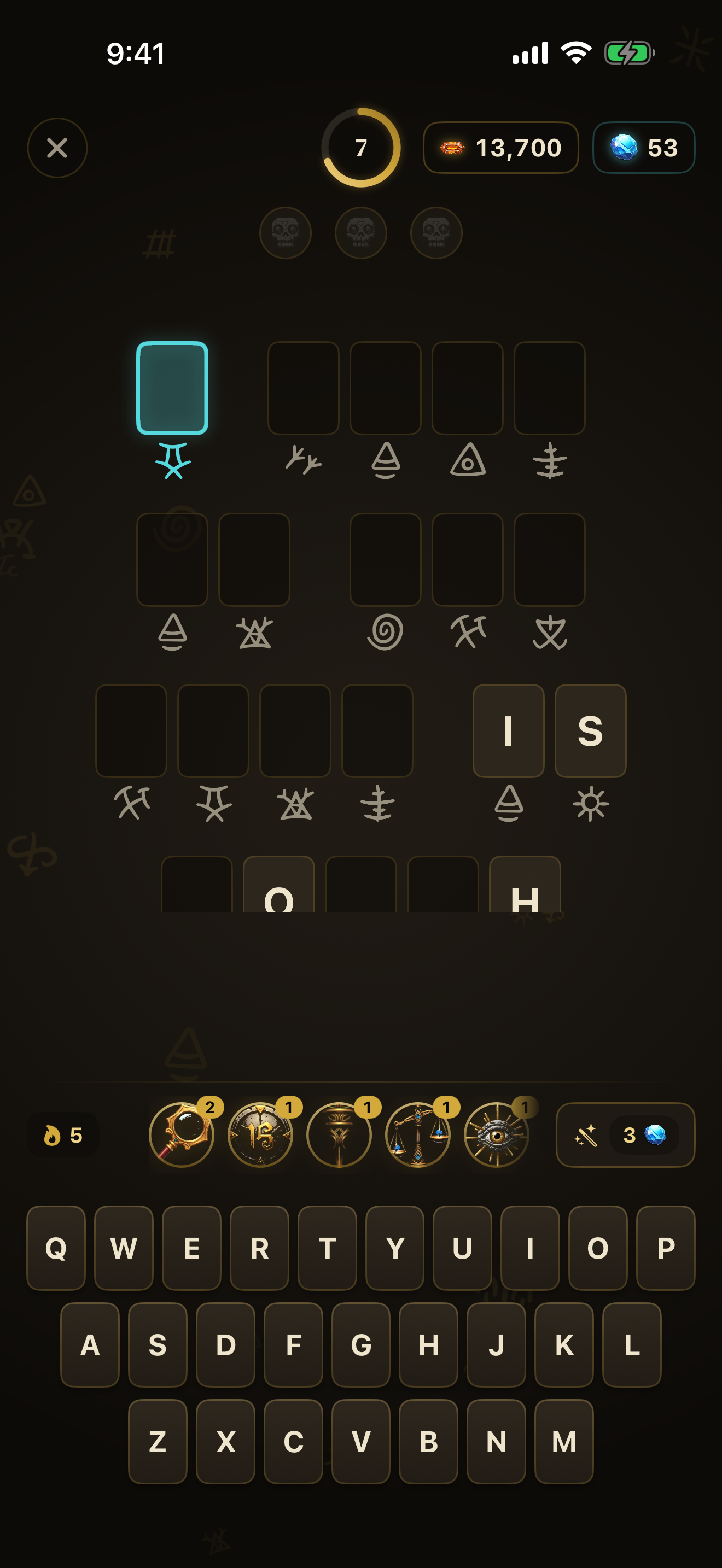
If you like finding words, Decode is your next obsession: every symbol hides a letter, and you decode the temple's phrases before three mistakes seal the door.
- 240 hand-crafted cipher puzzles across the Temple Ascent
- A fresh daily cipher to race - and a Crystal Mine for free gems
- No ads, no account required, iCloud sync
Free on the App Store · iPhone & iPad · No ads, no account.
Frequently asked questions
What is the first thing to do in a cryptogram?
Look for one-letter words - in English they are almost always A or I. Then find the most frequent cipher letter and try E. Those two moves alone usually give you a foothold.
What are the most common letters in English?
E, T, A, O, I, N, S, H, R - roughly in that order. E alone is about 12% of all letters, so the most common symbol in a long cryptogram is very often E.
What are the most common three-letter words?
THE by a wide margin, then AND, FOR, ARE, BUT, NOT, YOU, ALL. If a three-letter pattern repeats through the puzzle, THE is the first thing to test.
How long should a cryptogram take?
A short quotation might take two or three minutes once you have the method; a tough one with unusual words can take fifteen. Frequency analysis gets more reliable the longer the text.